Wednesday, January 15, 2014

READING RESPONSE: DIVERGENT BY VERONICA ROTH 

I wanted to read a different type of book this week, something more futuristic and exciting, and I came across Divergent by Veronica Roth. This book is set in the future in Chicago, when society has been completely changed. Now, when a child turns 16, they have to make a choice of a faction. There are five factions, and the one they choose is where they will stay for the rest of their lives. These five factions are Dauntless, Abnegation, Erudite, Amity, and Candor. Each one stands for a different personality. For example, Dauntless is for someone who is brave, and Abnegation are for the selfless people. The main character, Beatrice Prior chooses Dauntless, and has to go through the tough Dauntless initiation ceremony. The book is about how she struggles to truly become Dauntless and how she faces the strange rules of her society.

Although I am nearly finished, I predict that Beatrice will accomplish Dauntless initiation, but will soon be faced with even more challenges. Since she is extremely courageous, I believe that she can get past any problem that is thrown her way. 

In the beginning of the book, Beatrice was a shy girl from Abnegation. She followed all the rules and never took any risks. By the time she turned 16 and transferred to Dauntless, she has become a completely new person. Being in Dauntless means you have to face your fears, and she did so and although she did not become fearless, she became an experienced young woman. She learned to have more freedom and to stand up for herself, qualities that are not usually supported in Abnegation.

The Author, Veronica  Roth, is an extremely talented writer. She expresses the main character's inner feelings in a very interesting way, by allowing the reader to see all of Beatrice's thoughts, and how she struggles to make decisions. She also uses flashbacks, and shows Beatrice's previous life in Abnegation.

This book is amazing, and I can't wait to finish it so I can read the second one.

Wednesday, December 18, 2013


READING RESPONSE: RUNNING ON THE CRACKS BY JULIA DONALDSON

I have finished 'Life of Pi' by Yaan Martel, and I have begun 'Running on the Cracks' by Julia Donaldson, and it appeared very interesting. In the first few chapters I've read, I can gather that the main character is called Leo, and she has run away from her family. I'm still not sure why she ran away, but I assume I will learn soon. Finlay, a paper boy, comes across Leo when reading a section in the news labeled 'Missing Persons', and is determined to help her. At first, Leo was wary of him, and what his true intentions were, but now she trusts him. Finlay and Leo have already gone on many adventures, trying to avoid the police looking for Leo.

The inquiry question I chose for this book is 'Whose perspective is missing in this text? What would it be like if we put it back?' This book is mainly the perspective of the main character, Leo, although some chapters feature her sexually abusive uncle. The perspective missing is that of Leo's cousins, who bullied her, which is also another reason of why she ran away. I think it would be interesting to include these opinions, as it would show their reactions and whether or not they show remorse for driving Leo away.

I predict that Leo will be caught by the police or someone aware that she is a runaway. She has already had many close encounters and had to hide out at Finlay's house for a couple days. Leo probably won't last much longer without someone noticing her. I wonder how her family will react.

The author, Julia Donaldson, is a particularly interesting writer. This is her first young adult book, as she used to write children's books. Her most popular books are 'The Gruffalo' and 'The Gruffalo's child'. She also writes the book in different perspectives, such as the protagonist Leo, her sidekick Finlay,one of Finlay's relatives, Kim, and Leo's uncle.

So far, this book has been an amazing read, considering it is her first young adult book. I highly recommend it.

Wednesday, December 11, 2013

READING RESPONSE: LIFE OF PI BY YANN MARTEL

I am reading a very interesting book called the Life of Pi by Yann Martel. Although I am barely five chapters into the story, I can already see the book's potential. Using my knowledge so far I know that the book is told from the perspective of an Indian man looking back and reflecting on his past, starting from when he graduated college. This man is called Piscine Molitor Patel and he is narrating the story and informing the reader about his life when he was younger. 

Piscine, the main character, is a very clever (he graduated with double majors in religion and zoology) and thoughtful person. I predict that Piscine will tell us about his earlier years and will lead up to his great past adventure. I can relate to Piscine, and his yearn to reveal his past and the good times he had. I sometimes have the similar feeling of wanting to dive into the depths of my fondest memories of the past, and to embrace and reflect on them.

The social issue question I chose for this book was 'how does this text address the points of view (perspective) of other groups, especially those who usually don't get to tell their side?' This book largely focuses on the perspectives of the animals that Piscine is trapped on the boat with. Although the animals don't physically speak, the author focuses on their actions to show how they feel.
 
The author, Yann Martel, is an extremely descriptive writer. He makes the vibrant colors and feelings of the character's past come to life and explode in a shower of remarkable writing.He manages to somehow grasp the exact description of each moment and make it seem s real. I love reading his work because it makes me feel as if I am actually in the moment, and experiencing all the same feelings and thoughts as the main character.

I think Yann Martel wants us to comprehend our pasts and wonder about our futures, just like Piscine.  I think about the interesting way the author sets up the book, starting from the past and leading up to the future, but in the end, I actually makes the book more enjoyable. 

Wednesday, December 4, 2013


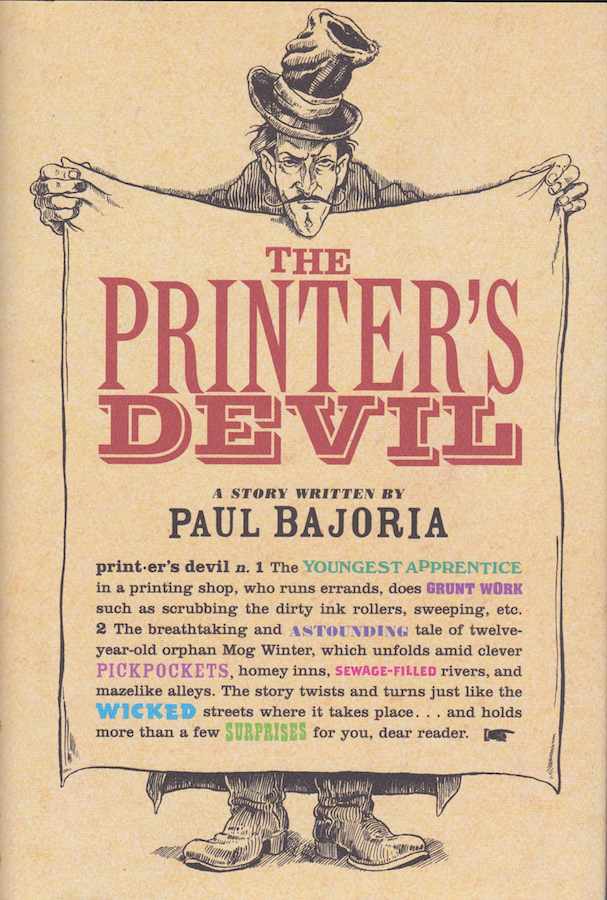
READING RESPONSE: THE PRINTER'S DEVIL BY PAUL BAJORIA

Currently, I am reading Paul Bajoria's "The Printer's Devil". This story takes place in Victorian England with a young orphan boy named Mog Winters. He embarks on a mystery involved with a ship's cargo, a murderer, and all the criminals in London. An important part in the book is when the main character Mog, discovers thieves stealing treasure and pursues them, only for them to kidnap him, which puts him on the trail of the mystery. This shows that Mog is an adventurous, curious, and daring character.

I admire his impulsiveness and how he relies on his instincts.I predict that with his now extensive knowledge of the mystery, he will be faced with many tricky and dangerous situations, and will meet another character to aid him on his mission. I can relate to Mog and his constant yearn for adventure. 

He also reminds me of another character, in the book "The Ruby in the Smoke" by Phillip Pullman. This book also takes place in victorian England, but with a spunky female lead who gets caught up in a mystery as well. 

Paul Bajoria uses many adjectives and descriptive actions in his book, which allows the story to become more exciting and suspenseful. I believe the author wants the readers to think about the experiences and joys of childhood, just like what Mog is going through in the story.

I often ask myself questions about Mog's recklessness and why he listens to his heart and not to his mind, but in the end I realize it is because he is still young and is trying to live his life to it's full potential. Throughout the story, after going through countless dangers, Mog becomes older and wiser, and his wisdom often comes from past experiences. This book is very touching but still tough and action filled, and I am enjoying it very much.

Wednesday, November 20, 2013


Cut and paste advertisements from a newspaper or magazine that make you react in a way that questions their motivation. Write about what you believe advertisers are trying to get you to think about.


“Peta”, a group working towards the ethical treatment of animals, presented this advertisement on multiple billboards. Normally, I agree with Peta’s arguments, as I am almost fully vegetarian myself, but when I saw this advertisement, I was shocked. I believe this advertisement was aimed to encourage people to become vegetarian by including a picture of a slightly chubby woman, as if to say that meat makes you gain large amounts of weight. Meat does in fact add to your weight, but only when multiple portions are consumed over a long period of time. This advertisement was urging women to become vegetarian to lose weight, which is a horrible incentive that will just make women feel more insecure about their bodies.

Monday, November 11, 2013


Should Young Adult Books be Banned from 6th Grade Libraries?

By Isobel Weiner 813


Dear Ms.Berner,

The banning of young adult books has become a very controversial topic. While some people involved in the literary world argue that certain books are just too dark for young readers, others protest against banning, saying it limits children from gaining knowledge and relating to the book. Young adult books should not be banned from 6th grade libraries because it would hinder readers from being educated or advancing, as well as holding them back from a whole new world which could help them deal with problems in their own lives.

Banning young adult books would hold back some 6th graders from advancing their reading skills. For example, banning books such as “The Perks of Being a Wallflower” by Stephen Chbosky would limit their knowledge on the subjects of depression, peer pressure, and sexual abuse. Chbosky’s book allows the reader to dive deep into the story of Charlie, the protagonist, who struggles through school socially and academically, while attempting to fit in as well. Reading books such as this that are above the average reading level would help the 6th graders to comprehend and understand more, making them more advanced readers over all.

Another example of why banning books in 6th grade libraries would be a bad choice is because it could take away the potential for a child to relate to the book. Sherman Alexie, the author of the novel “The Absolutely True Diary of a Part-Time Indian” discusses in his article “Why the Best Kids Books Are Written in Blood” how reading young adult fiction at a young age helped him “battle the real monsters” in his life. If a 6th grader is having problems at home, or is depressed, or anything of the sort, reading books with characters facing the same difficulties can help them. As Sherman Alexie writes in the last paragraph of his article, “And now I write books for teenagers because I vividly remember what it felt like to be a teen facing everyday and epic dangers. I don’t write to protect them. It’s far too late for that. I write to give them weapons – in the form of words and ideas – that will help them fight their monsters. I write in blood because I remember what it felt like to bleed.” Some teenagers relate so deeply to young adult books that they completely immerse themselves in the story, self-identify with the characters, and have their personality changed as a result of how meaningful the story was to them. This new study of how teenagers are affected by young adult books is discussed in the article “Reading Fiction ‘improves empathy’, study finds, US researchers measure impact of reading JK Rowling and Stephenie Meyer” by Alison Flood. The article states how researchers from the University of Buffalo gave students chapters from either 'Twilight' or 'Harry Potter and the Philosopher's Stone' to read. As written in paragraph two, "The candidates then went through a series of tests, in which they categorized "me" words (myself, mine) and "wizard" words (wand, broomstick, spells, potions) by pressing one key when they appeared on the screen, and "not me" words (they, theirs) and "vampire" words (blood, undead, fangs, bitten) by pressing another key." The result of the study was that people who read the Twilight passage self-identified as vampires, while people who read the Harry Potter passage self-identified as wizards. According to the article, "belonging to these fictional communities" can help improve the reader's mood and personality. This research shows how young adult fiction can deeply connect with the reader, and even positively affect their mood, both of which would be highly beneficial for 6th graders at Ms.51.   

Some people argue that young adult works are too lurid and dark for young readers, including Meghan Cox Gurdon, the author of the article “Darkness Too Visible”. Gurdon remarks in her article how teens will find themselves “surrounded by images not of joy or beauty, but of damage, brutality, and losses of the most horrendous kinds.” This statement can be completely refuted. While certain young adult books include dark aspects, over all they have a moral or a resolution, or even just an ending note that will educate the reader. Young adult is a very popular genre among teenagers, because the stories are moving and relatable, and they shouldn’t be banned just because specific parts contain questionable material.

In conclusion, young adult books should not be banned from 6th grade libraries because it would hold the students back from learning and expanding their knowledge, as well as robbing them of the opportunity to relate to the book, and use the moral of the story to help them face problems in their own lives.


Monday, October 14, 2013


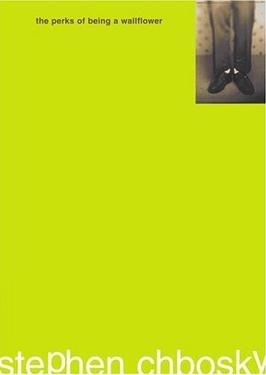
Reading Response: The Perks of Being a Wallflower by Stephen Chobsky


   Recently, I read 'The Perks of Being a Wallflower' by Stephen Chobsky, and it was an amazing book. It is split into four parts of diary entries from Charlie, a freshman in high school. Charlie is a young boy who has some issues, which as the reader finds out later, come from being sexually abused by his aunt Helen when he was little. The story focuses on how Charlie survives high school, socially and academically. When he meets his two best friends, Sam and Patrick, his life is momentarily turned around. The nightmares he had from aunt Helen became less frequent, and he didn't feel as lonely. Charlie goes through many teenage experiences, ranging from drugs, alcohol, sex, and relationships, and often they cause him to forget about his depression.

   This book is a lot more than just young adult fiction, it has a very captivating quality to it that will attract many readers. The moral of the story is to keep living your life, to not let depression or unhappiness get in your way, and I think that is a great moral which applies to people of all ages. Even when Charlie figured out that his aunt had touched him, he continued through high school and didn't let his troubling past hinder him.

   In the book, Charlie is treated unfairly, especially by his parents and peers. Whenever he tries to express himself it is frowned upon, and even though his parents love him, they often become frustrated over the amount of nightmares he has about Aunt Helen. He begins to drink and experiment with drugs to make friends, and that takes him down the wrong path, as he loses his friends because he was awful to his girlfriend. The issues of peer pressure, drugs, unhappiness, and alcohol are present in the book, and peer pressure especially affects Charlie because he is so desperate to have a good high school experience with friends.

   In conclusion, I loved this book, it was a memorable read and in the end, I felt like I had learned an important lesson. Stephen Chobsky is an extremely talented author. The diary entries he wrote made it seem like he was actually a fourteen year old boy, which helped me visualize the story much better. This book was incredible and I highly recommend it.