Wednesday, March 26, 2014

Writing Prompt By Isobel Weiner 813

In the article, "Should a Hated Word Be Banned?" Rabbi Dov Lipman says that "every country has to establish certain value-based limits" to free speech. Do you agree? Why or why not? Use evidence from the text to support  your response.

In the article, "Should a hated Word be banned?" Rabbi Dov Lipman states, "every Country has to establish certain value-based limits" to free speech. I agree with his statement because the word 'Nazi' and other Holocaust related slurs have such notorious reputations. Adolf Hitler's horrible acts are entwined with these words, and therefore it is for the benefit of the majority that these words be banned.

Even today, the word 'Nazi' brings up traumatic memories for the survivors of the Holocaust, which sadly, is fewer than 200,000 people. Among these terrible memories is the fact that "By the end of World War II in 1945, 6 million Jews had been killed, along with many Gypsies, homosexuals, and others the Nazis considered undesirable."

Trivial use of the word 'Nazi' is another reason to ban the offensive word. According to the article, the term is mentioned casually, in conversations ranging from Israeli politics to normal teenage talks. "We, in our land, can find enough words and expressions and idioms to express our opinions," says Shimon Ohayon, one of the lawmakers sponsoring the bill." Also, teenage Israelis use the word 'shoah' - which means "catastrophe" and is normally involved with the Holocaust - to describe an ending relationship or a messy kitchen. The casual use of the word is offensive and wrong, and therefore the word should be banned. Finally, Rabbi Dov Lipman was called a Nazi multiple times during protests in 2011 while he was trying to protect schoolgirls from religious mobs who considered their dress immodest. This is a completely wrong use of the word and is very offensive.

Additionally, the idea of banning Holocaust slurs is not too far fetched. "At least half a dozen European nations, along with Brazil, already prohibit the use of Nazi symbols and flags. Even more countries consider it a crime (as Israel has since 1986) to deny that the Holocaust took place."

Some people might say that 'Nazi' shouldn't be banned because it would take away the right of free speech. However, this first amendment right has exceptions. Among these exceptions are threats, false statements, and speech that incites violence. The word 'Nazi' fits in to all of these categories.

In conclusion, the word 'Nazi' should be banned because it is associated with too many horrible memories to be discussed trivially. It is an offensive word when used incorrectly or in the wrong context, and overall is a word with so much hatred attached to it, that it would be more beneficial to ban it.

Wednesday, March 19, 2014


READING RESPONSE: MOCKINGJAY BY SUZANNE COLLINS

I have nearly finished the final book in The Hunger Games series, Mockingjay by Suzanne Collins. This amazing book is about a place called Panem, or what used to be North America. Panem was split into 13 districts, with the Capitol ruling over all of them. One day, the districts rebelled against the dictatorial Capitol. Unfortunately, the Capitol won the war, and district 13 was destroyed. To keep a revolt from ever happening again, The Capitol set up The Hunger Games, a disturbing game in which 24 children had to fight to the death with all of Panem required to watch. The main character, Katniss, a young survivalist, has won two of these games with her companion Peeta. In this book, Katniss becomes the face of the latest rebellion against The Hunger Games and the Capitol. She and all the other rebels are determined to fight for their freedom.

I am very close to finishing this story, and I don't want to spoil it for people who haven't read it, so all I'm going to say is that I predict that Katniss will vanquish the Capitol and end the Hunger Games once and for all. Throughout the story, Katniss has grown and matured in so many ways. She stepped up to the challenge of becoming "the Mockingjay", or the face of the rebellion. She went through so much pain; being in the Hunger Games,facing The Captiol, witnessing so many deaths, and still she remains a tough determined girl.

The entire Hunger Games series is perhaps the best I've ever read. The author, Suzanne Collins has a beautiful way with words. When she writes, it hooks you into the story, and you can't seem to put it down. She lets the reader go deep into Katniss's head, and experience exactly what she is going through, as if you are actually in the moment. 

In conclusion, Suzanne Collins is an excellent writer, the book is a riveting page turner, and although it may seem  violent, I highly recommend it.

Thursday, February 27, 2014

Elizabethan Sonnet


The Mask
By Isobel Weiner 813 

A small smile is plastered onto her face
As if somehow it will hide the deep pain
Tears from before are gone without a trace
And she pushes down thoughts of the insane.

For during the day she is quite carefree,
But when the night comes she takes off the mask,
Which conceals something monstrous and scary,
Her dark feelings in which she must now bask.

And the tears threaten to spill down her cheeks
Her heart aches for the suffering to end,
But she lives with the pain for endless weeks
Stuck in her despair in which she must fend.

And she attempts to break free from the curse,
But that just makes the darkness become worse.

Thursday, February 13, 2014


Poetry Analysis Essay on Martin Espada
By Isobel Weiner 813

            Martin Espada is a Brooklyn born Latino poet. He grew up with his father, who was a leader in a Puerto Rican community and an activist who fought for equal opportunities for Hispanics. Because Martin was introduced to politics at such a young age, most of his poetry is political, specifically focusing on the culture and history of Latinos. The poems “Two Mexicanos Lynched in Santa Cruz, California, May 3, 1877”, “Revolutionary Spanish Lesson”, and “The New Bathroom Policy at English High School” by Martin Espada make the reader think about how the abuse of power can affect people and cultures, specifically Latinos.

            The first poem, “Two Mexicanos Lynched in Santa Cruz, California, May 3, 1877” has great emotional intensity because the abuse of power is so violent. The white people, or ‘gringos’ abuse the power of their ‘superiority’ given to them by society because of their race, by turning a lynching of two Mexicanos into a spectacle and then celebrating the event with a photograph. The quote, “More than the moment/when forty gringo vigilantes/cheered the rope/that snapped two Mexicanos/into the grimacing sleep of broken necks”, shows how the gringos turned the horrific event into a public viewing and treated the Mexicanos like hunted animals. The power felt by white people is so inbred that this gruesome event becomes a celebration to record with a photograph, “a high-collar boy smirking, some peering/from the shade of bowler hats, but all/crowding into the photograph.”

            In the poem “Revolutionary Spanish Lesson”, the white Americans abuse their ‘superior’ power that is given to them because of their race by mispronouncing the narrator’s name and assuming that he is a foreign Latino immigrant and is therefore unequal to them. This is indicated by Espada referring to “a busload/of Republican tourists/from Wisconsin”, which represents the most traditional white conservative group. Power in the hands of ignorant people causes the narrator to imagine himself as the revolutionary stereotype “Che Guevara”, which is evident when he states “I want to buy a toy pistol,/put on dark sunglasses,/push my beret to an angle,/comb my beard to a point.” The narrator has obviously experienced this lack of cultural awareness multiple times, and the anger he feels towards the more ‘powerful’ white Americans is striking.

            The narrator in the final poem, “The New Bathroom Policy at English High School”, demonstrates how the abuse of power by one individual can affect a whole group of people. In this case, the individual is the principal, who abuses his authority by deciding, “to ban Spanish/in the bathrooms” because he makes the assumption that students are talking negatively about him in Spanish. This is shown in the in the poem when Espada writes “The boys chatter Spanish/in the bathroom/while the principal/listens from his stall/The only word he recognizes/is his own name/and this constipates him.” He exerts his control over the students by enforcing this ban and no doubt causing the boys feel uncomfortable and excluded.

            In conclusion, each poem allows the reader to understand how the abuse of power can negatively affect people and cultures, and in Espada’s case, Latinos. The narrator evokes great empathy for the predicament of the Latinos when faced with the indignity of being considered inferior. Espada highlights how abuse of power can come from ignorance, racism, and disrespect, and how it can have such a deep affect on different cultures.

Wednesday, January 29, 2014


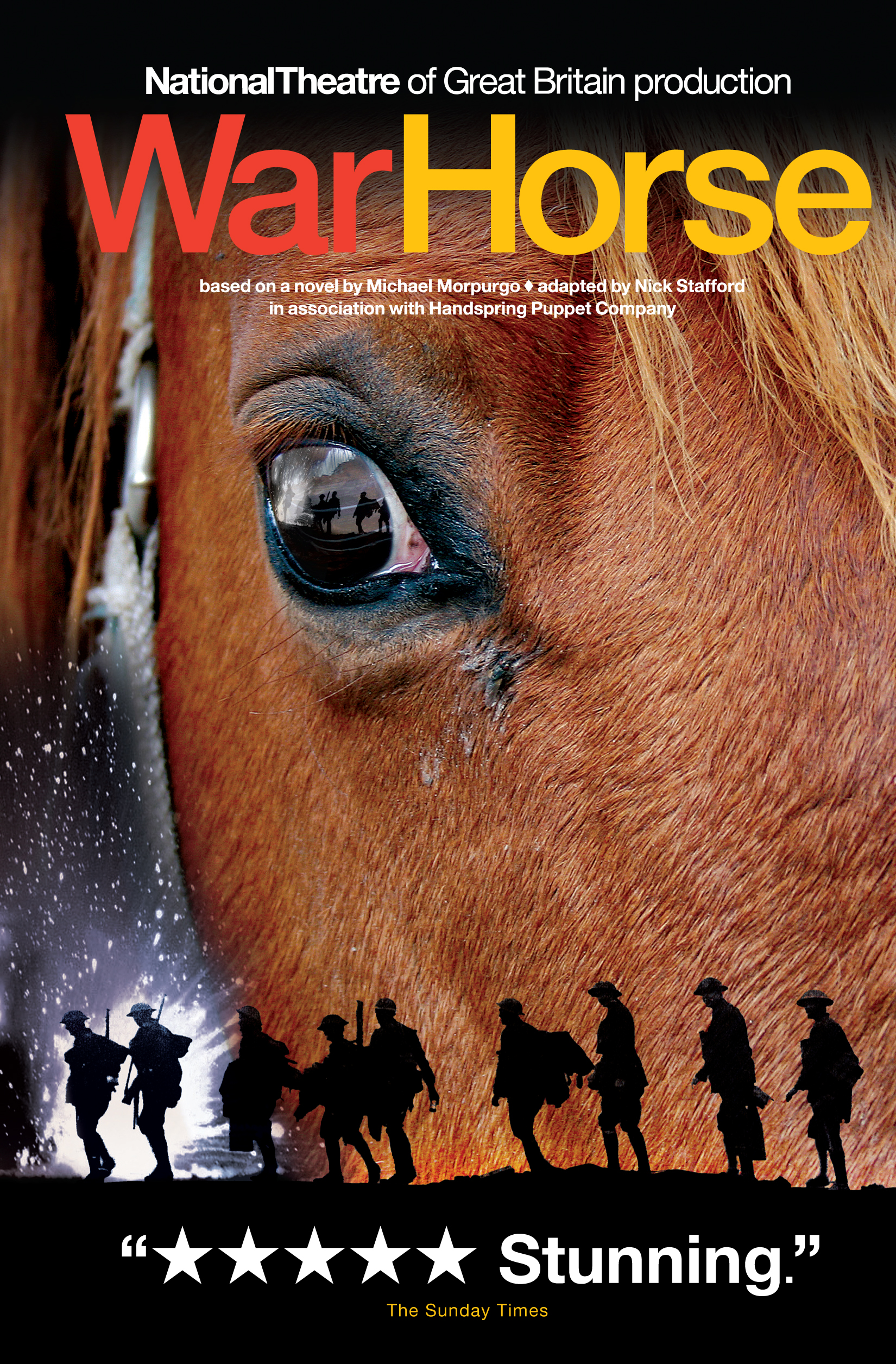
READING RESPONSE: WAR HORSE BY MICHAEL MORPURGO

Currently, I am reading War Horse by Michael Morpurgo. This book is about a young boy named Albert going through World War One with his horse as his only friend. One day Albert's father sells his horse, Joey, to serve in the army cavalry. Albert is devastated and once he comes of age, he joins the army to find Joey. Through battles and bombings he searches for Joey, until eventually he finds him.

I predict that Albert and Joey will have major difficulties while looking for each other, since World War One is raging all around them. Albert will probably have to decide which he prefers more: his life, or his horse. Albert is a courageous young boy, and his very determined;he must be if he is willing to enter a war zone for his horse.

Michael Morpurgo is an astonishingly good author. He has such a great fluency and voice in his writing. The book is a magical story from the beginning to the end.

In conclusion, I think the book is a wonderful piece of writing and is definitely one of the best I've read.

Wednesday, January 22, 2014


READING RESPONSE: INSURGENT BY VERONICA ROTH

After finishing Veronica Roth's first book, Divergent, I began to read her second book, Insurgent. In the end of Divergent, the main character Beatrice Prior became involved in a war between the factions Dauntless, Erudite, and her former faction, Abnegation. The faction full of people desperately seeking knowledge is Erudite. Erudite developed a potion that controlled all the minds of the Dauntless, and forced them to kill innocent Abnegation, who where withholding information from the Erudite. Since Beatrice is divergent, she is immune to the potion, and she starts out on an adventure to the Erudite headquarters, in order to stop all this madness. So far I am up to a very action filled part where the other factions (such as Amity and Candor), who weren't originally involved in the war join Beatrice In her attempt to conquer the Erudite.

It is amazing how much Beatrice has matured throughout both books. In the first book, she was a shy girl from Abnegation, and now she is at the head of an extremely violent war for information. She has truly become Dauntless. When she first transferred factions, anything slightly risky terrified her, but now she willingly jumps off moving trains, or shoots a gun. I'm not sure if this change is for the better, but it certainly makes her more useful during wartime.

I predict that Beatrice will be successful in breaching the Erudite headquarters, but judging from Veronica Roth's style of writing, she will completely flip the outcome, such as the leader of Erudite knew they were coming and set up a trap.

I'm very disappointed because the author hasn't written the third book in this series yet, so when I finish this book, I will have to wait until the next one is published. The author, Veronica Roth has a very unique style of writing. She uses flashbacks from a lot of different characters, and allows the reader to enter each characters mind.


This book is amazing, it might even be better than the first book. I highly recommend it.

Wednesday, January 15, 2014

READING RESPONSE: DIVERGENT BY VERONICA ROTH 

I wanted to read a different type of book this week, something more futuristic and exciting, and I came across Divergent by Veronica Roth. This book is set in the future in Chicago, when society has been completely changed. Now, when a child turns 16, they have to make a choice of a faction. There are five factions, and the one they choose is where they will stay for the rest of their lives. These five factions are Dauntless, Abnegation, Erudite, Amity, and Candor. Each one stands for a different personality. For example, Dauntless is for someone who is brave, and Abnegation are for the selfless people. The main character, Beatrice Prior chooses Dauntless, and has to go through the tough Dauntless initiation ceremony. The book is about how she struggles to truly become Dauntless and how she faces the strange rules of her society.

Although I am nearly finished, I predict that Beatrice will accomplish Dauntless initiation, but will soon be faced with even more challenges. Since she is extremely courageous, I believe that she can get past any problem that is thrown her way. 

In the beginning of the book, Beatrice was a shy girl from Abnegation. She followed all the rules and never took any risks. By the time she turned 16 and transferred to Dauntless, she has become a completely new person. Being in Dauntless means you have to face your fears, and she did so and although she did not become fearless, she became an experienced young woman. She learned to have more freedom and to stand up for herself, qualities that are not usually supported in Abnegation.

The Author, Veronica  Roth, is an extremely talented writer. She expresses the main character's inner feelings in a very interesting way, by allowing the reader to see all of Beatrice's thoughts, and how she struggles to make decisions. She also uses flashbacks, and shows Beatrice's previous life in Abnegation.

This book is amazing, and I can't wait to finish it so I can read the second one.